
Home › Solutions › Server Room Monitoring
Solutions · MonitorServer Room Temperature Monitoring — Know Before It Cooks
A failed air-con unit on a Friday evening can take a server room past safe temperature by Saturday morning. TITAN IoT is the appointed HW Group distributor for Ireland — we supply monitoring that watches temperature, humidity, doors, power and water leaks around the clock, and tells the right people the moment something drifts. From one comms cabinet to a national estate of rooms.
Get a Monitoring Recommendation
What Is Server Room Temperature Monitoring?
Server room temperature monitoring is a small hardware device installed in an IT room or comms cabinet that continuously measures temperature — and usually humidity, door status, power and water leaks — and sends alerts by email, SMS or a local siren when readings cross preset warning or critical thresholds. Unlike software that monitors the servers themselves, it watches the environment the servers live in, so a failed air-conditioning unit, an open door or a burst pipe is caught before hardware is damaged. Standalone LTE versions alert even when the site network or power is down.
The same hardware monitors fridges, plant rooms, cold stores and any small technical space — a server room is just the most common install.
Five Ways a Server Room Fails Quietly
Every one of these is invisible until it isn’t — and every one is a sensor.
Cooling Failure
The air-con trips or ices up and the room climbs degrees per hour. Temperature probes with warning and critical thresholds catch it while there’s still time to act.
Open or Forced Doors
A door contact knows when the room is opened — after hours, unexpectedly, or left ajar with the cooling fighting the corridor.
Water Where It Shouldn’t Be
AC condensate, a leaking roof, a burst pipe above the rack. A leak-sensing cable under the floor or along the wall alarms on first contact with water.
Power Events
Detect mains loss on a socket or monitor a UPS environment — and with an LTE unit, the alert still gets out when the power and network are down.
Humidity Drift
Too dry invites static; too damp invites condensation and corrosion. Combined temperature-humidity probes watch both ends.
Three Sizes of Answer — One Room to a National Estate
All HW Group, all supported from Galway. Which tier fits depends on how many rooms and whether you can rely on the site network.

STE2 — On Your Network
Ethernet/Wi-Fi unit with temperature-humidity probes and digital inputs for a door contact. Email alerts on warning and critical thresholds, free HWg-cloud portal, simple web setup. The right answer for one room with a reliable network.
View the STE2 r2 STE2 LITE
Perseus 145 — Independent Over LTE
Monitors over its own LTE connection — no dependence on the site network. SMS and email alerts direct from the unit to multiple recipients, warning and critical thresholds, and a relay output that can drive a local siren on critical alarm. One unit per site, identical setup in every city. Requires a SIM per unit — supplied with our IoT SIMs or yours.
View the Perseus 145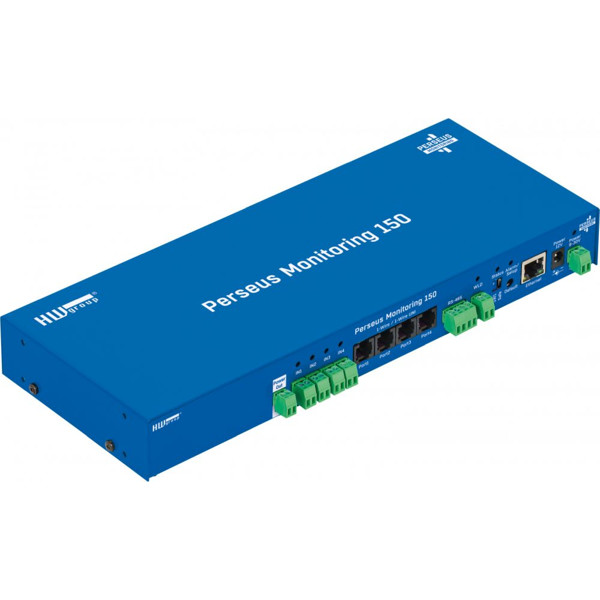
Perseus 150 — The Rack Flagship
Rack-mount monitoring for serious rooms: more sensors, more inputs, per-rack visibility. Paired with a SensDesk portal it becomes fleet monitoring — every room, every site, one dashboard, with reporting for compliance. The path from “a few rooms” to a managed estate.
View the Perseus 150Add-On · Water Leak Detection
 The WLD2 quad water leak detector runs sensing cable under raised floors, along AC units and around pipe runs — four zones per unit, alarming on first contact with water. Water damage is one of the most expensive failures a server room can have, and one of the cheapest to detect.
Sensors for Every Signal
The monitoring unit is the brain — the probes decide what it can see. These are the ones we fit most, all in stock in Galway:
Temperature & humidity: HTemp HomeBox — the standard room probe · Temp-1Wire Pt100 — wide-range probe for freezers and extremes
Air quality: CO2 1W-UNI — CO2 for occupied technical spaces
Industrial integration: HTemp-485 Modbus RTU — ties readings into BMS and SCADA
Door contacts, smoke, power detection, leak cable and more — HW Group’s catalogue runs to hundreds of devices and sensors, and as appointed distributor we supply any of them. If it needs watching, ask us for the right probe.
HWg-cloud Free, SensDesk When You Grow
Every HW Group device connects to HW Group’s own portals — no software to install, nothing to maintain on your side.
Note the Perseus 145 sends SMS directly from the device over LTE — so device-level SMS alerting works even on the free portal tier. We’ll recommend the honest minimum for your setup, and it’s often the free one.
Where This Hardware Is Already Working
Server Room, Temperature + Door
An STE2 with a temperature probe and door contact watches a customer’s server room — alerting on heat rise and on the door opening. Two sensors, one small box, the whole failure surface covered.
University Research Fridges
A university runs student experiments in monitored fridges using HW Group NB-IoT loggers — fully independent of the campus network, reporting straight to the cloud. Installed quickly, no IT project required.
Beyond the Server Room
The same platform monitors cold stores, plant rooms and pharma storage across Ireland — if it has a temperature that matters, it’s the same solution. See our environmental monitoring range.
Server Room Monitoring Questions, Answered
What is server room temperature monitoring?
It’s a small hardware device installed in an IT room that continuously measures temperature — and usually humidity, door status and water leaks — and alerts by email, SMS or a local siren when readings cross preset thresholds. It watches the environment the servers live in, catching cooling failures, open doors and leaks before hardware is damaged.
Can I set separate warning and critical alert levels?
Yes — HW Group units support multiple thresholds per sensor, so a warning at, say, an elevated temperature goes to email while a critical level triggers SMS and a local siren. Alert recipients are configurable per level, to several people.
Can it send SMS alerts to more than one person?
Yes. The Perseus 145 sends SMS directly from the unit over LTE to multiple recipients (a SIM is required in the device), and portal-side SMS and voice-call alerting is available on SensDesk paid plans for network-connected units like the STE2.
Can it sound an alarm in the room itself?
Yes — units with a relay output, such as the Perseus 145, can switch a local buzzer or siren directly on a critical alarm, so anyone near the room hears it even before the messages land.
Does it work if our network or power goes down?
That’s exactly what the LTE tier is for. The Perseus 145 monitors and alerts over its own cellular connection, independent of the site network — and portal heartbeat monitoring can alert you when a device itself goes silent, which is often the first sign of a site-wide outage.
Do I need to install any software?
No. Configuration is through the unit’s built-in web interface, and cloud visibility comes from HW Group’s portals — the free HWg-cloud for basic email alerting, or SensDesk paid plans for SMS, reports and multi-site dashboards. TITAN pre-configures units in Galway so they arrive ready to connect.
We have rooms in different cities — does that change the answer?
It usually points to the standalone LTE tier: one Perseus 145 per site, identically configured, each alerting independently of local networks and IT departments. A portal then gives one dashboard across all sites. It’s the pattern we recommend most for two-to-twenty distributed rooms.
Tell Us About Your Rooms
How many rooms, where, and what worries you — we’ll recommend the smallest solution that genuinely covers it, configured in Galway and supported after.
TITAN IoT Ltd · Racecourse Business Park, Ballybrit, Galway, H91 A9NN
+353 91 757500 · iot@titan.ie