Secure Remote Access — without static IPs or open ports.
SmartNetVPN is a VPN platform built for industrial and IoT networks. Every router, machine, camera or sensor joins one encrypted private network with its own fixed internal address — so your team reaches equipment on any site from anywhere, without renting static IPs, running DynDNS, or exposing a single device to the internet.
TITAN IoT runs it as a managed service and is the listed SmartNetVPN distributor for Ireland. We pre-enrol every device before dispatch, supply the licences and help you run the fleet — so your hardware arrives staged, labelled and ready to plug in.
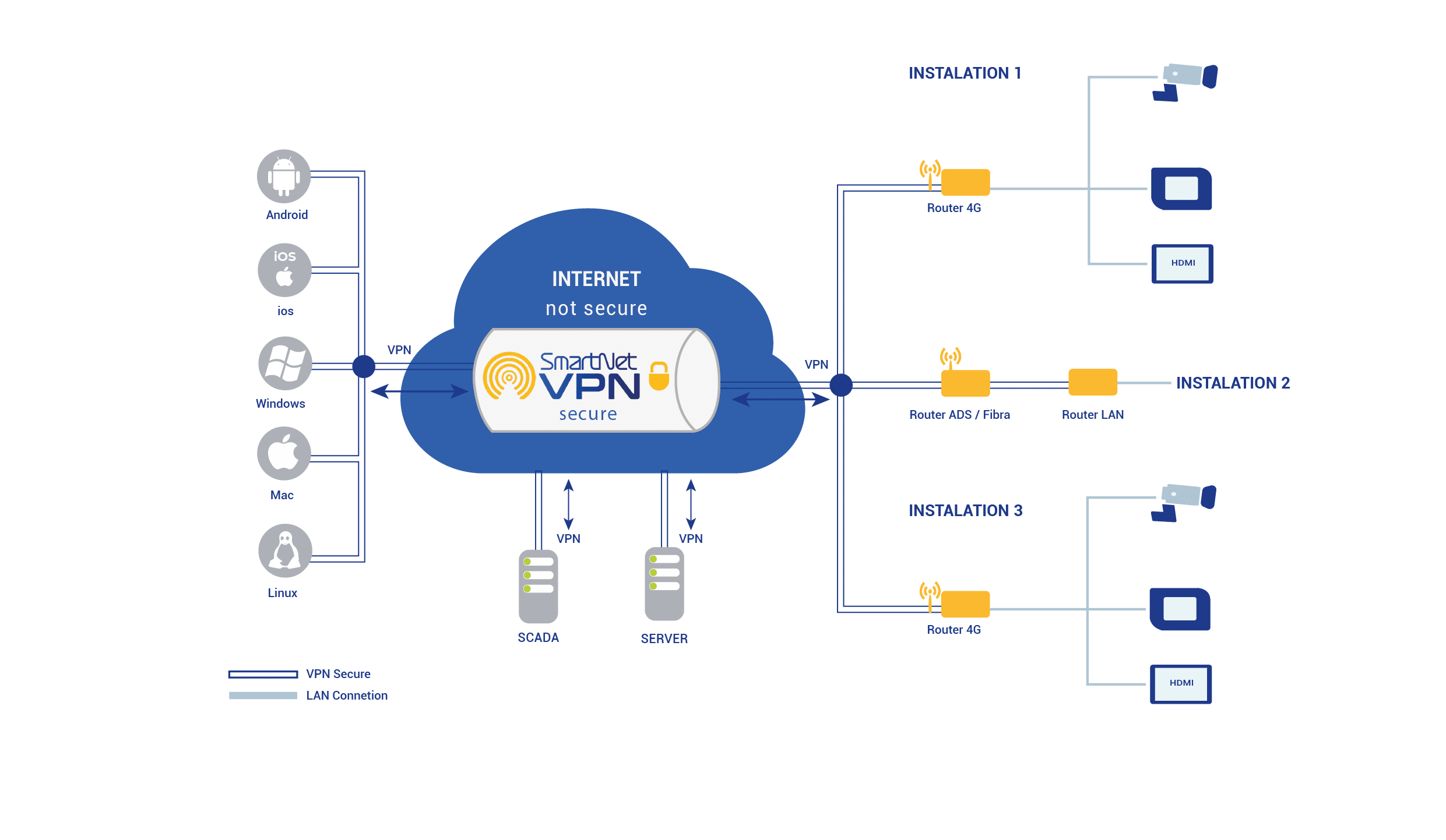
One private network across every site, whatever the connection
What Is an Industrial VPN?
An industrial VPN is a private encrypted network that connects field equipment — routers, PLCs, cameras, meters and sensors — to the people and software that need to reach them. Each device gets a fixed private address, and traffic between it and your office travels inside an encrypted tunnel rather than across the open internet.
It matters because the alternatives are all bad. Renting a static IP for every SIM is expensive and ties you to one operator. DynDNS with port forwarding is fragile and puts equipment on the public internet where anyone can find it. A VPN removes both problems at once: devices connect outward to the network, so they work on ordinary SIMs behind carrier-grade NAT, and nothing is exposed inbound.
Your Equipment. Someone Else’s Site.
This is the situation almost every customer arrives with, in one form or another.
You have equipment installed somewhere you don’t control — a machine on a customer’s factory floor, an inverter on a farm, a monitoring station on a industrial site, a charger in a car park. It’s your equipment. You’re responsible for it. But it lives on somebody else’s premises.
So how do you reach it? Ask their IT department for a hole in their firewall, and you’ll wait weeks and be refused half the time — reasonably, because you’re asking them to accept a risk for your convenience. Use their network, and every change they make can knock you offline with no warning. Drive to site each time, and a five-minute check costs half a day.
The answer is to bring your own connection. A small cellular router beside your equipment, on your own SIM, joined to your own private network. It doesn’t touch their network, doesn’t need their permission, and doesn’t care what they change. Your equipment is reachable from your office the day it’s installed — and it stays that way.
Machine builders
Your machine ships to a customer anywhere and you can still support it — diagnostics, updates, fault finding — without asking them for network access or sending an engineer.
Service & maintenance contractors
You maintain equipment across dozens of customer sites. One private network reaches all of them, and no customer has to change anything for you.
Renewable installers
Inverter monitoring on a customer’s roof or field, over your own cellular link, so your performance data keeps flowing whether or not their broadband is working.
Monitoring & instrumentation
Analysers, environmental stations and meters installed on host sites — your software reaches your instruments directly, on addresses you control.
What It Takes Off Your Bill
The security argument is the obvious one. The cost argument is usually what gets the project signed off.
No static IP addresses
Static IPs are charged per SIM, every month, forever. On a fleet of any size that becomes the largest line on the connectivity bill — and SmartNetVPN removes the need for them entirely.
No DynDNS subscriptions
The platform handles addressing itself, so third-party dynamic DNS services and their annual fees come out of the stack.
No operator lock-in
Because the private addressing is yours rather than the network’s, you can change SIM provider or move a site to fixed line without reconfiguring anything.
No site visits for access
Diagnostics, configuration changes and firmware updates happen from a desk. On a dispersed estate the travel saved usually pays for the service in the first year.
Deployed Without Configuring Tunnels By Hand
The platform generates the configuration files for your routers and end devices automatically. A router is enrolled, its config is applied, and it appears on the private network with its own fixed address — no hand-built tunnels, no per-device certificate wrangling, no firewall changes on the customer’s network.
You choose the shape of the network to suit the job: star where everything reports to a central office, point-to-point for a direct site-to-site link, or mesh where sites need to reach each other as well as head office.
If a connection drops, devices reconnect automatically. If a laptop is lost or someone leaves, their credentials and active sessions are revoked instantly from the portal.

The Router Is the Client
This is the part that makes it simple. You don’t install anything on the machine, the camera or the PLC — the router at the site carries the VPN client, and everything behind it comes onto your private network with it. Drop a router in, and the site is reachable.

Robustel R1510
The compact workhorse — one machine, one cabinet, one site. The most common endpoint we ship.
View the R1510
Robustel R5010
5G where the site needs bandwidth — camera backhaul, video, busy multi-device locations.
View the R5010
Advantech SmartStart
The compact ICR unit for tight cabinets and controller enclosures, widely deployed on infrastructure.
View the SmartStart
Teltonika RUT241
Cost-effective at volume — EV chargers, kiosks and rollouts where the unit count is high.
View the RUT241Whatever sits behind the router — a PLC, a camera recorder, an analyser, a meter concentrator — joins the network without being touched. See the full router range ›
Your Team Carries the Other End
The router puts the site on the network. A client on your device puts you on it — and that client runs on Windows, macOS, Linux, iOS and Android. So the same private network reaches an engineer’s laptop in the office, a manager’s phone at home, and a technician standing in a plant room.
That last one matters more than it sounds. A rugged tablet running Windows is a full PC in a case built for site work — so the diagnostic software your engineers already use runs on it, connected over the VPN, in the rain, in front of the machine. No laptop balanced on a control panel, no phoning the office to ask someone to check a value.
Access follows the person, not the desk. And when someone leaves, their access is revoked in seconds from the portal.

One client, every platform — desk, field and pocket
What You Get in the Portal
Security
AES-256 encryption with X.509 certificate authentication, two-factor authentication on the management portal, and instant revocation of users, devices and live sessions.
Deployment
Automatic generation of router and device configuration files — zero-touch provisioning — plus automatic configuration backup for fast recovery.
Organisation
User roles and groups, so you can segment the network by customer, site or project and give each team access only to what it should see.
Visibility
Connection logs recording source IP, session times and data volume per node — useful for troubleshooting, and for demonstrating who accessed what.
Cloud, or Your Own Servers
Most customers take the hosted option — the server runs in the cloud, including on AWS, Google Cloud or Azure, and there is nothing for your IT team to maintain.
Where policy requires network control to stay in-house, the same platform runs on your own infrastructure, virtualised under VMware, Hyper-V or Docker. For public bodies, utilities and organisations with data-residency requirements, that option is often the deciding factor.
Runs on
Cloud — AWS, Google Cloud, Azure or hosted for you
On-premise — VMware, Hyper-V or Docker on your own servers
Clients — Windows, Linux, macOS, iOS and Android
Field access — engineers connect from laptops, phones or rugged tablets on site
It Works With the Routers You Already Have
SmartNetVPN is not tied to one manufacturer. That matters on real estates, where the kit was bought over a decade from whoever was best at the time.
Supported hardware includes Robustel and Teltonika routers — the two ranges we stock most — alongside Advantech, Red Lion, Hirschmann, Cybertec and Celerway equipment, plus PCs, servers, video recorders and mobile devices.
A site running Robustel and a site running Teltonika sit on the same private network, managed from the same portal. If you are moving off a manufacturer’s locked-in access box, this is usually the point that decides it: you keep your hardware, your SIMs and your machines’ fixed addresses, and take ownership of the access.

Where It’s Used in Ireland
Industrial & Machine Access
Reaching PLCs, SCADA and control systems for diagnostics and updates without a site visit — the core case, covered in depth on our machine connectivity page.
CCTV Where There’s No IP to Connect To
The classic problem: a recorder on a 4G site with no public address, behind carrier-grade NAT, and nothing to point your viewing software at. The VPN gives that recorder a fixed private address you connect to directly — no port forwarding, no static-IP SIM, and the cameras never appear on the public internet to be found and probed.
Renewable Energy
Inverter telemetry and monitoring on solar and wind sites — often remote, often on cellular, always needing reliable access for performance data and fault diagnosis.
EV Charging Networks
Chargers dispersed across car parks and forecourts, each needing secure back-office connectivity without a static IP per unit. See EV charger connectivity.
Branch & Multi-Site Offices
LAN-to-LAN interconnection between offices and depots, centrally administered, with the same access rules everywhere.
Remote Infrastructure
Pump houses, telemetry stations, server rooms and technical sites needing round-the-clock availability — see also server room monitoring.
A VPN Needs Endpoints
SmartNetVPN is the access layer. We supply everything it connects, configured together in Galway so the network comes up as one system.
Industrial Cellular Routers
Robustel, Teltonika, Advantech and Digi 4G and 5G routers — enrolled on your VPN before dispatch.
Browse RoutersIoT SIMs
Multi-network SIMs that roam across Irish operators. With SmartNetVPN you don’t need the static-IP versions — which is where the saving comes from.
See IoT SIMsIndustrial Gateways
Edge computing and protocol gateways joining the same private network as everything else.
Browse GatewaysRCMS Router Management
Free with every Robustel — RCMS manages the router itself, SmartNetVPN reaches what sits behind it. They complement each other.
About RCMSWhere This Fits in a Wider Project
Secure access is usually one part of a bigger job. These are the solutions it most often forms part of.
Machine Connectivity & Remote Access
The full picture for machine builders and service teams — router, antenna, SIM and VPN staged together, with real deployment examples.
View SolutionEV Charger Connectivity
Chargers dispersed across car parks and forecourts, each needing back-office connectivity without a static IP per unit.
View SolutionServer Room & IT Monitoring
Environmental and power monitoring for comms rooms — reached securely wherever the room happens to be.
View SolutionSolar & Renewables
Installer connectivity independent of the customer’s network — inverter monitoring that keeps reporting whatever happens to their broadband.
View SectorIndustrial VPN Questions, Answered
What is an industrial VPN?
A private encrypted network connecting field equipment — routers, PLCs, cameras, meters and sensors — to the people and software that need to reach them. Each device gets a fixed private address, and traffic travels inside an encrypted tunnel rather than across the open internet. Devices connect outward, so nothing is exposed to inbound attack.
Do I still need static IP SIM cards?
No, and that is usually the biggest saving. Static IPs are charged per SIM every month by the operator. Because SmartNetVPN devices connect outward to the platform, they work on ordinary SIMs behind carrier-grade NAT — more secure than a public address, and without the recurring charge.
Will it work with the routers we already have?
In most cases, yes. SmartNetVPN is hardware independent and supports Robustel, Teltonika, Advantech, Red Lion, Hirschmann, Cybertec and Celerway equipment alongside PCs, servers and mobile devices. Mixed estates run on one network and one portal. Send us a list of what you have and we’ll confirm.
Can we host it on our own servers?
Yes. The platform runs in the cloud — including AWS, Google Cloud and Azure — or on your own infrastructure under VMware, Hyper-V or Docker. Organisations with data-residency or network-control policies usually choose on-premise.
Our machines have fixed IP addresses set by PLCs. Is that a problem?
No. Machines whose local addresses cannot change are normal. The VPN maps a private address to each machine’s existing local address, so nothing on the machine is reconfigured and your existing diagnostic software connects as it always has.
How does TITAN supply SmartNetVPN, and what does it cost?
We run it as a managed service. TITAN pre-enrols every device before dispatch, supplies the licences and helps you run the fleet — so hardware arrives staged, labelled and ready to plug in, rather than as a login and a manual. Cost depends on how many devices you are connecting and whether you want the hosted service or the platform on your own servers. Tell us roughly how many devices and we’ll quote in euro.
Take Ownership of Your Remote Access
Tell us how many devices you need to reach, what hardware they run on and whether you want cloud or on-premise hosting — we’ll size the licence and stage the whole system in Galway.
TITAN IoT Ltd · Racecourse Business Park, Ballybrit, Galway, H91 A9NN
+353 91 757500 · iot@titan.ie
Listed SmartNetVPN distributor for Ireland