
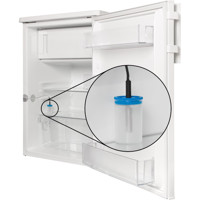
Refrigerated containers and cold storage rooms underpin a lot of Irish business — food storage, pharmaceutical handling, cold-chain logistics, laboratory storage, event catering, distribution centres and temporary chilled facilities all depend on them. They are built to hold stable low temperatures, but they are surprisingly hard to monitor.
This article covers a practical approach to that problem: reliable, cloud-logged, alert-driven temperature monitoring for refrigerated containers and cold rooms in Ireland — without battery sensors inside the cold space, without Wi-Fi dependency, and without an ongoing maintenance schedule. The recommended solution uses three components: HW Group’s STE2 R2 PoE monitoring unit, the Temp-1Wire-Flat IP67 fridge probe with under-door-seal cable, and SensDesk cloud monitoring with email alerts.
Why refrigerated containers are difficult to monitor
The same properties that make a refrigerated container hold cold air well also make it a poor environment for wireless sensors.
- Insulation — typically 50–100mm of polyurethane foam, which significantly attenuates 2.4GHz Wi-Fi.
- Steel construction — the outer skin reflects and blocks RF, producing a Faraday-cage effect.
- Sealed doors — gaskets and metal frames close off the small RF leakage paths a normal building offers.
- Cold operating temperature — battery-powered sensors lose capacity at low temperatures, and lithium chemistries that perform well at room temperature can deliver a fraction of their rated life at −20°C.
A Wi-Fi sensor placed inside a fully-loaded refrigerated container often cannot reach an access point sitting metres away. A cellular sensor inside the same container may not see the network. A battery-powered LoRaWAN sensor will usually work — but battery life drops noticeably at refrigerator and freezer temperatures, and the sensor itself sits inside the cold space, which shortens the replacement cycle.
Wired sensing avoids all four problems.
The recommended approach
For an installation where reliability matters and battery maintenance is unwanted, the combination below is the cleanest fit.
| Component | Role |
|---|---|
| HW Group STE2 R2 | PoE-powered Ethernet monitoring unit, one per cluster of probes |
| Temp-1Wire-Flat 3m probe | IP67 stainless-steel probe with flat under-door-seal cable |
| SensDesk cloud portal | Live temperature data, email alerts, history graphs |
| External waterproof enclosure | Houses the STE2 R2 outside the cold space |
| PoE switch | Powers all STE2 R2 units from one network point |
The principle is straightforward. The monitoring electronics sit outside the refrigerated space in a waterproof enclosure. The probe sits inside, sensing the actual zone temperature. The flat ribbon cable routes between the two — under the door seal — without compromising the seal or requiring a drilled penetration through the container wall.
Why the flat-cable probe is the right choice
HW Group makes two 3m probes that look similar at first glance. The difference matters for refrigerated container installations.
| Probe | Cable | Range | Use case |
|---|---|---|---|
| Temp-1Wire-Outdoor 3m | Round PVC | −50°C to +125°C | General outdoor measurement: pipes, plant rooms, external walls |
| Temp-1Wire-Flat 3m | Flat ribbon | −30°C to +60°C | Refrigerator and cold-room monitoring — routes under door seal |
The round-cable outdoor probe is rated to a wider temperature range, but it cannot pass under a refrigerated container door without lifting the gasket — which compromises the seal and the cold chain. The flat-cable variant is purpose-designed for the application: the ribbon profile routes under the gasket without obstructing the seal, so the container closes and seals normally.
HW Group’s product documentation explicitly recommends the flat-cable variant for fridge applications. For typical Irish cold storage — chilled at +4°C, frozen at −18°C to −20°C — the −30°C rating provides comfortable headroom, and the under-seal cable solves the practical installation problem cleanly.
For deep-freeze applications below −30°C, the outdoor probe with cable extension is the alternative, but those installations are uncommon in Irish cold-chain work.
How the STE2 R2 fits
The STE2 R2 is HW Group’s mid-range monitoring unit. Each unit supports up to five 1-Wire sensors, two digital inputs (for door contacts, leak detectors and similar dry-contact inputs), and connects to the network over Ethernet with PoE or over 2.4GHz Wi-Fi. For refrigerated container installations, Ethernet with PoE is the right choice — one cable carries data and power, no local power supply is needed at each monitoring point, and there are no Wi-Fi penetration issues to design around.
The unit has a built-in web server for configuration, supports SNMP for integration with existing network monitoring systems, and pushes data to SensDesk for cloud logging and email alerts.
Because one STE2 R2 can handle up to five probes, the unit count depends on layout rather than sensor count. A site with four probes in two physical clusters might use two STE2 R2 units; a site with four widely-separated probes might use four. The 1-Wire bus has a documented maximum wiring length of 60 metres from an active port, so cable run feasibility usually drives the layout decision.
A representative example — Dublin, three zones
A recent enquiry from a Dublin business illustrates how this fits together in practice. The customer operates a refrigerated container installation made up of three temperature-controlled zones.
- Zone 1 — one refrigerated container, single sensor point
- Zone 2 — three containers merged into one large chilled room, two sensor points for coverage across the merged space
- Zone 3 — one refrigerated container, single sensor point
The recommended specification:
- 4 × Temp-1Wire-Flat 3m probes (one per sensing point)
- 2 × HW Group STE2 R2 PoE units, each handling two probes, mounted externally between paired zones
- 2 × external IP-rated enclosures
- PoE switch outside the chilled structure, connected to the customer’s existing network
- SensDesk cloud subscription for logging and email alerts
Each STE2 R2 draws power from the PoE switch over a single Cat5e/6 run. Each probe sits inside its assigned zone, with the flat cable routed under the door seal. SensDesk receives data from both STE2 R2 units, displays live values per zone, logs history for cold-chain records, and triggers email alerts when any zone breaches its configured high or low threshold.
Cloud monitoring and alerts with SensDesk
SensDesk is HW Group’s monitoring portal. Two versions are available: HWg-cloud.com is the free tier with basic dashboards and email alerts, and SensDesk.com is the paid professional tier with longer data retention, more devices per account, advanced dashboards and API access.
For a typical Irish cold-storage installation, the platform provides:
- Live temperature readings per zone
- Historical graphs and trend data
- Per-sensor high and low threshold alerts
- Email notifications when a zone moves outside its safe range
- Multi-device management from one login
- Data export for cold-chain records and operational reporting
SensDesk does not replace formal HACCP record-keeping, but the historical logs and threshold-breach alerts support most cold-storage monitoring requirements. Specific compliance setups should always be checked against the site’s internal procedures and the relevant industry regulations.
Where this approach fits
Wired PoE temperature monitoring suits any Irish site where the cold space is well-insulated, where wireless signal will not reliably penetrate, where battery maintenance is unwanted, and where a single network point can be brought close to the installation:
- Food storage and processing facilities
- Cold-chain logistics and distribution centres
- Pharmaceutical and medical storage
- Laboratory cold storage
- Temporary refrigerated container sites — events, construction, overflow capacity
- Catering and hospitality cold rooms
- Warehouses with chilled or frozen zones
For sites where wireless is genuinely viable — well-ventilated cold rooms within Wi-Fi range, or single-room installations with a clear RF path — battery-powered LoRaWAN sensors can be a simpler choice. The wired approach earns its keep on multi-zone, heavily-insulated, or long-term installations where reliability and maintenance footprint matter more than the simplicity of dropping a battery sensor on a shelf.
Frequently asked questions
What is the best way to monitor temperature in refrigerated containers in Ireland?
For heavily-insulated or metal-lined refrigerated containers, a wired probe-based system is generally more reliable than wireless sensors. The insulation and steel construction that retain cold air also attenuate Wi-Fi and cellular signals. A PoE-powered Ethernet monitoring unit mounted outside the container, with an IP67 probe routed inside, gives stable readings without battery maintenance or signal-penetration issues.
Can a temperature probe sit inside a refrigerated container without compromising the door seal?
Yes — provided the right probe is used. HW Group’s Temp-1Wire-Flat 3m probe has a flat ribbon cable specifically designed to route under refrigerator and cold-room door gaskets. The container closes and seals normally, the probe sits inside, and the monitoring unit stays outside in a waterproof enclosure.
Why choose PoE over Wi-Fi for cold storage monitoring?
PoE consolidates power and network onto one cable, which removes the need for a local power supply at each monitoring point and eliminates the Wi-Fi penetration problem inside the insulated structure. It also removes the battery replacement schedule that comes with wireless sensors.
How many probes can one STE2 R2 monitor?
Up to five 1-Wire sensors plus two digital inputs per STE2 R2. The total 1-Wire bus length should not exceed 60 metres from an active port, so layout and cable run feasibility usually drive the unit count rather than the sensor limit.
What temperature range does the recommended probe cover?
The Temp-1Wire-Flat 3m probe is rated −30°C to +60°C, which covers chilled storage (typically +2°C to +8°C) and standard frozen storage (typically −18°C to −25°C) with comfortable headroom. For deep-freeze applications below −30°C, the round-cable outdoor probe (−50°C to +125°C) is an alternative, but the cable cannot route under a standard door gasket.
How are alerts delivered when a temperature goes out of range?
The STE2 R2 supports email alerts directly. With SensDesk cloud monitoring, alerts can be sent by email, and SMS is available via an external HWg-SMS-GW3 gateway. Each sensor has its own configurable high and low thresholds.
Is this system suitable for HACCP or cold-chain records?
SensDesk’s historical logs and threshold-breach alerts can support cold-storage monitoring records, but specific compliance requirements should always be checked against the site’s internal procedures and the relevant industry regulations. The platform is a monitoring tool, not a certified compliance system.